
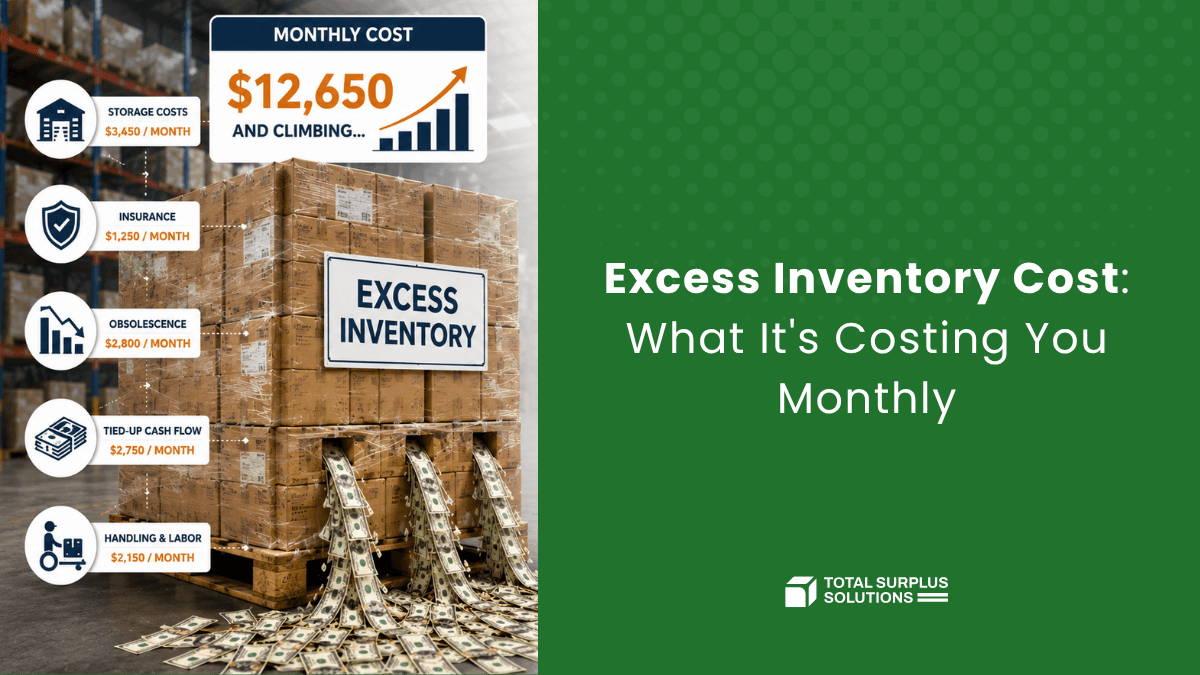
Every day you hold unsold inventory; your warehouse quietly writes you a bill. Most business owners never see it because it never arrives as a single invoice.
Most business owners think of excess inventory as a problem they will deal with later. But “later” has a price tag. Whether you run a retail shop, manage a warehouse, or oversee a manufacturing operation, carrying more inventory than you can sell is one of the most expensive silent drains on your cash flow.
This article breaks down exactly how much excess inventory cost per month, gives you a formula to calculate your own number, and helps you understand why moving slow stock is almost always better than storing it.
What Is Inventory Carrying Cost?
Inventory carrying cost (also called holding cost) is the total expense of storing unsold goods over a period of time. It includes far more than just warehouse rent.
The standard formula looks like this:
Carrying Cost (%) = (Total Annual Holding Costs / Average Inventory Value) x 100
For monthly purposes, divide the annual percentage by 12.
Industry benchmarks consistently put carrying costs between 20% and 30% of inventory value per year. That means if you are sitting on $100,000 worth of excess inventory, you could be losing $1,667 to $2,500 every single month just by doing nothing.
The Six Hidden Costs Eating Your Margins
Most business owners only think about storage when they think about carrying costs. The reality is far more layered. If you want a deeper look at how these costs affect the business beyond the balance sheet, see our breakdown of why holding excess inventory costs more than you think.
1. Storage and Warehousing (25-30% of total carrying cost)
This is the most visible cost. Whether you own your facility or lease it, every square foot occupied by slow-moving inventory has an opportunity cost. That space could hold faster-turning products, be subleased, or simply reduce your footprint. For businesses paying warehouse leases in urban markets, storage costs can be as high as $12 to $30 per square foot annually.
2. Capital Cost (20-30% of total carrying cost)
This one gets overlooked almost universally. The money tied up in unsold goods is money that could be working for you elsewhere, whether that is paying down debt, funding marketing, or buying inventory that actually sells. The cost of capital is typically measured at your weighted average cost of capital (WACC) or at minimum, the interest rate you would pay to borrow that same cash.
3. Insurance (2-5% of total carrying cost)
Most insurance policies are valued based on the goods you hold. More inventory means higher premiums. Many businesses do not realize that dead stock is inflating their insurance costs month after month.
4. Labor and Handling (10-15% of total carrying cost)
Staff hours spent counting, moving, organizing, and managing inventory add up. Every time a team member touches a pallet of slow-moving goods, that labor cost compounds. Cycle counts, stock checks, and reorders all require human time, and slow inventory clogs those workflows.
5. Obsolescence and Depreciation (10-25% of total carrying cost)
This is where things get painful. Products lose value over time. Consumer electronics may depreciate 30-50% in under a year. Seasonal goods become nearly worthless within weeks of their window closing. Fashion items, perishables, and trend-driven products all carry steep obsolescence risk the longer they sit.
6. Shrinkage, Damage, and Theft (2-5% of total carrying cost)
The longer goods stay in a facility, the more opportunities there are for things to go wrong. Packaging deteriorates. Products get damaged during reorganization. Theft risk increases with inventory density.
Calculate Your Monthly Excess Inventory Cost
Here is a simplified version you can use right now:
Step 1: Identify the value of your slow-moving or excess inventory.
Step 2: Apply the carrying cost percentage range (use 25% as a conservative midpoint).
Step 3: Divide by 12 for the monthly cost.
Example:
- Excess inventory value: $80,000
- Annual carrying cost at 25%: $20,000
- Monthly cost: $1,667
If you have $250,000 in excess stock sitting in your warehouse, that number jumps to $5,208 per month. Not as a worst-case scenario. As a reasonable estimate. For a more detailed method of identifying exactly which stock qualifies as excess before running this calculation, read our guide on how to calculate excess inventory.
Why Businesses Keep Holding On (And Why That Thinking Is Costly)
There are a few common reasons businesses hold onto excess stock longer than they should.
The first is the sunk cost fallacy. “We paid $40 for those units. We are not selling them for $15.” The $40 is already spent. Holding the product does not recover it. Every month of storage is an additional loss on top of the original one.
The second is lack of visibility. Many operators simply do not know how much their slow stock is costing them because those costs are spread across multiple line items. Warehouse costs live in one budget. Insurance in another. The total picture is rarely assembled.
The third is uncertainty about alternatives. What can you actually do with 2,000 units of a discontinued product? The answer is quite a lot, and often faster than most businesses expect. Working with Excess Inventory Buyers who purchase across virtually every product category and condition, including overstock, customer returns, discontinued goods, and damaged items, removes the guesswork entirely.
What Businesses Are Doing Instead
Forward-thinking retailers, wholesalers, and manufacturers are increasingly turning to direct inventory liquidation to recover value from excess stock rather than continuing to absorb holding costs month after month.
The math supports this clearly. If a direct buyout returns even 30 cents on the dollar for inventory that would otherwise cost you 2.1% per month to hold, you recover more value by acting now than by waiting. Add in freed capital, reduced labor overhead, and reclaimed floor space, and the case becomes even stronger.
Working with a direct inventory buyer means no coordinating with multiple platforms, no waiting on auction timelines, and no uncertainty about whether the stock will move. Businesses across retail, wholesale, manufacturing, and distribution are using this approach to turn idle inventory into usable capital quickly.
The key is finding a buyer that handles the full range of inventory conditions, from overstock and discontinued goods to customer returns and damaged items, so you are not left managing what does not fit a narrow criteria. If you are ready to take that step, you can sell your inventory directly without the back and forth of traditional liquidation channels.
Frequently Asked Questions
What is a normal inventory carrying cost percentage?
Most supply chain professionals use 20% to 30% of inventory value per year as the standard range. The exact figure depends on your industry, storage costs, and how capital-intensive your business is. High-cost urban warehouses and product categories with rapid obsolescence (electronics, seasonal goods, fashion) tend to sit at the higher end of that range.
How do I know if I have excess inventory?
Common indicators include stock that has not turned in 90 days or more, rising storage costs without a corresponding rise in sales, products that are no longer part of your active catalog, and goods tied to a promotion or season that has passed. Most inventory management systems can flag slow-moving SKUs by setting minimum turn rate thresholds.
Is it better to discount excess inventory or liquidate it?
This depends on your brand positioning and the volume involved. Deep discounting can move units, but it trains customers to wait for sales and can undercut your regular pricing. Selling directly to a liquidation buyer moves volume without affecting your retail pricing environment or brand perception. For large quantities or discontinued items, direct liquidation is often the cleaner financial and operational choice.
What types of businesses tend to carry the most excess inventory?
Retailers, importers, wholesalers, and manufacturers with seasonal demand patterns tend to accumulate excess inventory most frequently. Businesses that rely on bulk purchasing for margin tend to overbuy during favorable conditions and are left with surpluses when demand softens. Companies that lack real-time inventory visibility are also more prone to accumulation because they are not catching the problem early enough to act on it.
The Bottom Line
Excess inventory is not a storage problem. It is a cash flow problem, a margin problem, and an opportunity cost problem happening at the same time.
At 25% carrying cost annually, every $100,000 in slow-moving stock costs your business roughly $2,083 per month. For many businesses, that number is several multiples higher than they have ever calculated.
The first step is running the numbers for your own operation using the formula above. The second step is acting on what you find before another month of holding costs compounds the loss further.
Total Surplus Solutions works directly with retailers, wholesalers, manufacturers, and distributors to purchase surplus stock outright with no drawn-out process. Whether you are dealing with overstock, customer returns, discontinued products, or damaged goods, the goal is to recover capital fast and free up space.
Knowing your number is the start. Acting on it is where the recovery begins.