
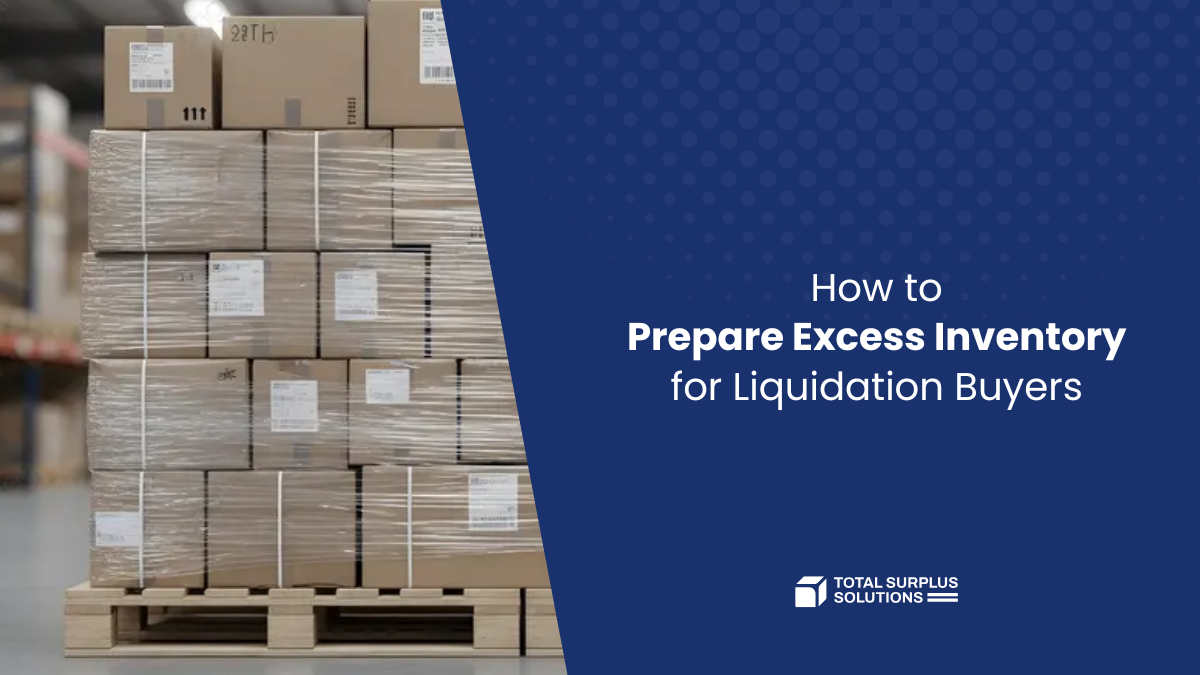
Inventory liquidation often breaks down long before pricing is discussed. In many cases, the issue is not buyer interest. It is preparation.
Manufacturers, distributors, and retailers could be in a situation where they have to liquidate with incomplete data, conflicting lists of inventory, or unrealistic notions of how buyers evaluate risk. This could cause slower decision-making, retraded offers, or unnecessary friction.
While preparation is not a guarantee of success, it is an assurance of greater clarity, speed, and credibility. Buyers can make faster decisions with more organized data. Discussions about prices are clearer with aligned expectations that meet reality.
This article outlines how to prepare excess inventory properly before engaging liquidation buyers. The goal is not to complicate the process. It is to remove avoidable mistakes that undermine deals.
Start With a Clear Inventory List of What You Want to Sell
Before speaking with any buyer, the first step is internal clarity.
It is surprisingly common for businesses to approach liquidation without fully defining what is actually being offered. Teams may recognize they have “too much inventory,” but they might not know which SKUs, how many units, what condition those units are in, or where they are located.
A clear inventory list should include:
- SKU or product name
- Quantity on hand
- Basic product description
- Packaging condition
- Location of inventory
This does not require a complex data export. What matters is accuracy and consistency.
One of the fastest ways to stall a liquidation process is to send a rough spreadsheet with unclear quantities, mixed conditions, and placeholder notes. Buyers price risk. When data is incomplete, risk increases. When risk increases, pricing softens.
It is also important to separate different types of inventory. Slow-moving retail-ready products should not be mixed with returns, damaged packaging, or obsolete items. Each category has a different resale profile.
Preparation at this stage saves hours of work later.
Gather Accurate Product Images That Buyers Actually Need
Images are not cosmetic. They are operational.
Buyers need to see what they are evaluating. That means more than a catalog photo or marketing image pulled from a website.
Practical liquidation images should show:
- The front of the product packaging
- The back of the packaging with specifications
- The condition of cartons or cases
- How the inventory is palletized or stored
For instance, a pallet of packaged small appliances may look good at first glance. However, upon closer inspection, the buyer may find crushed corners, out-of-date packaging, or mixed cartons. Ultimately, the buyer is going to notice all of this. Giving the buyer this type of information up front is going to help them trust you.
It is also important to show scale. A single unit on a desk does not communicate a lot size. A clear image of pallets or stacked cartons helps buyers visualize logistics and resale potential.
Providing accurate visuals reduces guesswork. Guesswork, in liquidation, usually works against the seller.
Include UPCs, SKUs, or Other Identifying Information
Identification details are often overlooked, but they play a big role in buyer confidence.
UPCs, SKUs, model numbers, or other identifiers help buyers to:
- Verify product specifications
- Confirm market presence
- Assess resale channels
- Avoid confusion with similar products
Without identifiers, buyers must rely entirely on descriptions and images. That uncertainty often translates into conservative pricing.
In some cases, inventory may lack standard UPCs. Private label products, discontinued items, or packaging updates may complicate identification. When that happens, clarity in descriptions becomes even more important.
If identifiers exist, include them. If they do not, acknowledge that early and provide as much structured information as possible.
This is not about formality. It is about reducing ambiguity.
Understand Your Lot Size, Weight, and Packaging Details
Logistics plays a larger role in liquidation than many operators anticipate.
Buyers evaluate not only product value but also handling effort. A truckload of neatly palletized cartons is different from loose mixed cartons scattered across multiple locations.
Before engaging buyers, clarify:
- Total unit count
- Total pallet count
- Approximate weight
- Dimensions per pallet
- Whether inventory is floor-loaded or palletized
- Number of warehouse locations involved
These details influence freight planning, labor requirements, and absorption capacity.
For example, a regional buyer may be comfortable picking up two truckloads from a single distribution center. The same buyer may hesitate if inventory is spread across five facilities in different states.
Logistical clarity signals professionalism. It also prevents unexpected cost deductions during finalization.
Set Realistic Pricing Expectations Before Value Erodes
Pricing is where many liquidation efforts derail.
It is important to approach pricing discussions with a clear understanding of how secondary markets operate. Buyers do not evaluate inventory based on original cost or historical retail price. They assess:
- Current demand in resale channels
- Category saturation
- Condition and packaging
- Logistics complexity
- Speed of execution
Excess inventory often carries urgency. The longer it sits, the fewer options remain. Waiting for a higher price rarely improves outcomes unless underlying demand changes materially.
Setting realistic expectations internally before engaging buyers prevents emotional negotiation later. It allows decision makers to weigh recovery against ongoing carrying costs.
A common mistake is anchoring to sunk costs. Once inventory is classified as excess, the relevant comparison is not the original margin. It is the cost of holding versus the benefit of redeploying capital.
Preparation at this stage is less about numbers and more about mindset.
Why Preparation Influences Buyer Behavior
Liquidation buyers evaluate risk quickly. Well-prepared sellers reduce perceived risk. Reduced risk often leads to faster decisions and cleaner transactions.
Consider two scenarios:
In the first, a seller sends a vague email describing “mixed consumer electronics inventory” with estimated quantities and no images. Buyers respond cautiously, ask several follow-up questions, and adjust their offers as more details come in.
In the second, a seller provides a structured spreadsheet, clear pallet counts, front-and-back images, and UPC details. Buyers can evaluate resale options right away and provide focused feedback.
The inventory may be the same in both cases, but the outcome is different. Preparation does not raise the inherent product value. It improves transaction efficiency.
Tradeoffs to Consider Before Moving Forward
Preparing excess inventory for liquidation also forces internal decisions.
Should you break large lots into smaller segments to attract more buyers, or keep them consolidated to simplify logistics?
Should you separate high-performing SKUs from slower ones, or bundle them to move more volume at once?
There is no universal answer. Larger, mixed lots often move faster but at blended pricing. Segmented lots may improve recovery on specific SKUs but require more time and coordination.
Preparation provides the clarity needed to evaluate these tradeoffs intentionally rather than reactively.
How Total Surplus Solutions Fits into the Preparation Process
For many businesses, the issue is not necessarily that they are not aware of the existence of extra inventory, but that they are not sure how to effectively prepare it for sale. This is where Total Surplus Solutions comes in, working with manufacturers, distributors, and retailers to look at the inventory on a “lot” basis before it enters the secondary market. The goal here is to effectively prepare the inventory for sale, ensuring that there are no mistakes that prevent a smooth and efficient sale.
This context-driven approach helps businesses avoid common mistakes that slow down transactions. It is less about marketing inventory and more about presenting it accurately, so decisions can be made quickly and efficiently. When preparation is done thoughtfully, inventory liquidation becomes a controlled process instead of a frantic scramble.
Closing Perspective
Preparing excess inventory for liquidation buyers is straightforward. It takes discipline, clear thinking, and realistic expectations.
Clear inventory lists reduce confusion. Accurate images reduce uncertainty. Proper identifiers reduce ambiguity. Logistics transparency reduces friction. Realistic pricing reduces delay.
Most liquidation challenges are not caused by buyer behavior. They are caused by incomplete preparation and misaligned expectations.
For executives and operators managing excess inventory, preparation is the one variable fully within your control. While it does not assure that you will receive the highest possible price, it does ensure that you will receive it in a straight line.
In inventory management, clarity is more valuable than optimism.