
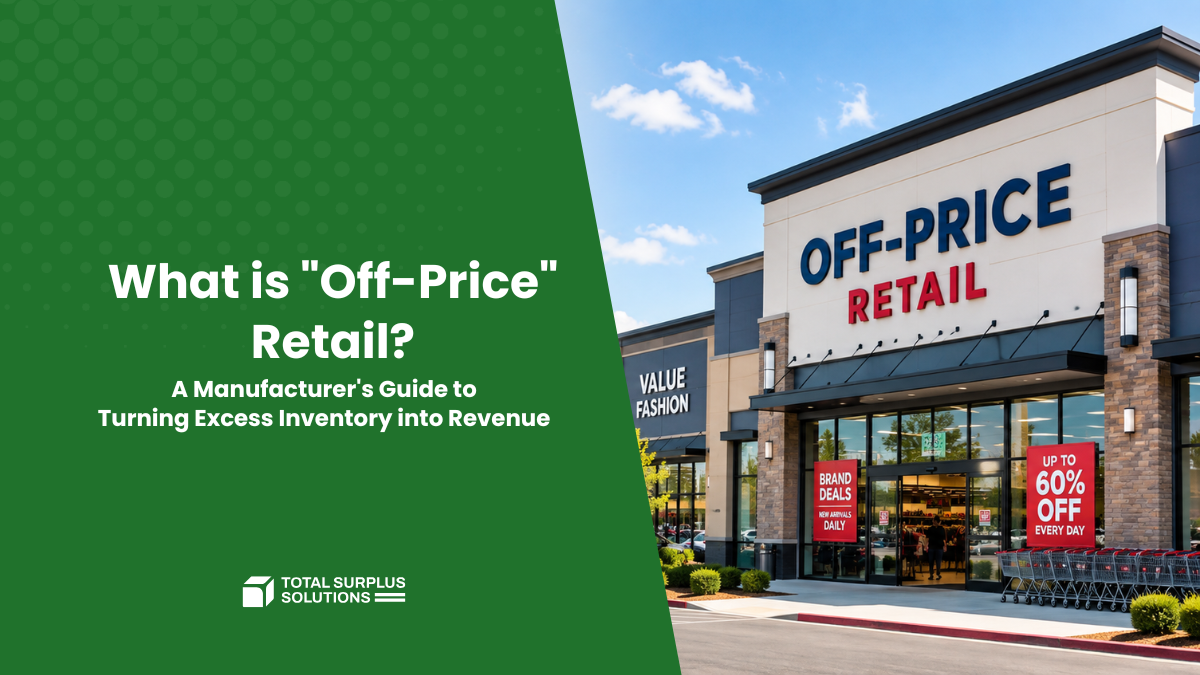
A Manufacturer’s Guide to Turning Excess Inventory into Revenue
If you manufacture branded goods, you’ve likely dealt with more inventory than your normal channels could absorb. Overproduction, a cancelled order, a season that ended with product still on the shelf. That leftover stock has to go somewhere, and increasingly, it’s going through off-price retail. It’s one of the fastest-growing sectors in retail, and understanding how it works is the first step to using it as an asset instead of writing off the loss.
Off-Price Retail Definition
Off-price retail is a business model built on buying branded merchandise below wholesale cost, then reselling it below standard retail prices, typically at discounts of 20% to 60%. Off-price retailers are independent operators. They don’t manufacture anything. Their entire business is acquiring surplus inventory from brands like yours and moving it through their own stores or channels.
Some of the biggest names in the space, T.J. Maxx, Marshalls, Ross Dress for Less, Burlington, HomeGoods, and Nordstrom Rack, built their entire business model on exactly this kind of surplus. Between them, these retailers operate thousands of stores nationwide, and all of that shelf space needs a constant supply of new merchandise coming in.
For a manufacturer, that’s the key detail. Off-price retailers exist specifically to absorb the inventory your standard distribution channels weren’t built to handle.
Off-Price vs. Outlet vs. Discount Store
These three get lumped together constantly, but they work differently, and the difference matters for where your excess stock ends up.
| Format | Who runs it | What it sells | Major examples |
| Off-price retailer | Independent company | Mixed brands, sourced from many manufacturers | T.J. Maxx, Marshalls, Ross Dress for Less, Burlington, HomeGoods, Nordstrom Rack |
| Factory outlet | The brand itself | Its own overstock, seconds, or outlet-made goods | Brand-run outlet stores |
| Discount store | Independent company | Goods bought at standard wholesale, sold at thin margins | Regional and value chains |
Off-price retailers aren’t tied to any single brand’s supply chain, which is exactly what makes them a reliable outlet for excess inventory regardless of which brand it’s coming from.
If This Sounds Familiar, You’re Not Alone
Excess inventory usually comes from a handful of predictable situations:
- Overproduction. You manufactured more than the market absorbed.
- Cancelled orders. A retailer backed out after the goods were already made.
- End-of-season overstock. Product that missed its selling window.
- Closeouts. A line is being discontinued and needs to move.
Every one of these leaves you holding inventory that isn’t going to sell through your normal channels. Off-price retail exists specifically to solve that problem.
The “Treasure Hunt” Effect (and Why Your Brand Is Safe)
Off-price retail keeps shoppers coming back for a reason the industry calls the “treasure hunt.” Customers never know exactly what they’ll find on a given visit at chains like T.J. Maxx or Ross, and that’s by design. Assortments are sourced opportunistically instead of planned and repeated, so inventory turns over constantly.
Here’s what that means for you as a manufacturer: your presence in an off-price store is temporary and known to be temporary. Consumers understand that what they see today may be gone tomorrow, which means your brand’s image in its normal retail channels stays untouched. Seeing your product at a discount once doesn’t stop a customer from paying full price for it elsewhere later. If anything, it often works the other way. A shopper who tries your brand at a bargain price and likes it frequently becomes a full-price customer through your standard retailers going forward.
Why Manufacturers Turn to Off-Price
Off-price retail gives you a channel to turn closeouts and excess inventory into revenue without disrupting the relationships and pricing structure you’ve built everywhere else. It’s discreet by nature, since the constantly rotating assortment means your product isn’t sitting there long enough to become anyone’s lasting impression of your brand. And because value-minded shoppers are drawn to the format regardless of how the broader economy is doing, it stays a dependable outlet whether consumers are cutting back or spending freely.
Picture a mid-sized apparel brand that overestimates demand for a seasonal line. By the time the season ends, a few thousand units are still sitting in the warehouse, too late to sell through the usual retail partners at full price. Selling that stock at a steep discount through its own stores would undercut the brand everywhere else. Moving it through an off-price retailer instead clears the inventory, brings in revenue that would otherwise be a straight loss, and does it without a single full-price customer ever seeing a discount on that same product in a normal store.
How to Sell to Major Off-Price Retailers
Manufacturers sell excess stock through a few channels, selling directly to individual off-price retail chains, working through inventory liquidation buyers who specialize in placing this kind of inventory, or partnering with a buyer who already has relationships across the major off-price retailers and can move product quickly without you having to manage those relationships yourself.
Selling direct to individual chains means negotiating separately with each retailer, which can work if you only have one or two accounts to place stock with, but it slows down considerably once you’re dealing with multiple SKUs across multiple seasons. Liquidation buyers solve that speed problem but vary widely in how selective they are about condition, packaging, and brand fit, so the terms are worth checking closely before committing volume.
The fastest path is usually a buyer who already has standing relationships across the major off-price retailers. That means one conversation and one transaction instead of a dozen, and it means your inventory gets evaluated and placed by someone who already knows which retailers are the right fit for it. You get paid, the product moves, and your standard distribution channels never have to know the difference.
Turn Your Excess Inventory into Revenue
If you’re a manufacturer sitting on closeouts or excess inventory, Total Surplus Solutions buys it directly. We have close relationships with the nation’s top off-price retailers, including T.J. Maxx, Marshalls, Ross Dress for Less, Burlington, HomeGoods, and Nordstrom Rack, so your merchandise gets placed quickly, safely, and discreetly, protecting your brand while turning dead stock into cash.
Have inventory to move? Contact us today for an offer.